Honored to be one of seven faculty members awarded the Tohoku Gakuin University’s Outstanding Faculty Member for Educational Achievements in 2022.
2022年度東北学院大学教育功績優秀教員として表彰された7名の教員の一人です。学生に感謝いたします。
University page:

Honored to be one of seven faculty members awarded the Tohoku Gakuin University’s Outstanding Faculty Member for Educational Achievements in 2022.
2022年度東北学院大学教育功績優秀教員として表彰された7名の教員の一人です。学生に感謝いたします。
University page:
In a course titled Japanese Society and Culture, students were asked about their food and drink preferences. 86 students responded. (Survey date: October 28, 2025). They provide answers to these questions: Is rice truly Japan’s staple food? Can everyone stomach raw fish delicacies such as sushi and sashimi? Is the national dish of curry rice really loved by everyone? What percent of students refrain from drinking both tea and coffee? Which noodle is king in Japan? And what’s the most popular ramen soup?
| Question | Everyday | Resps. | Not everyday | Resps. |
| Generally speaking, how often do you eat rice? | 73% | 63 | 27% | 23 |
| Question | Yes | Resps. | No | Resps. |
| Do you think you can live without rice? | 73% | 20 | 27% | 66 |
| Question | Rice | Resps. | Bread | Resps. | Noodles | Resps. | Other |
| What is the most important staple food for you? | 88% | 76 | 7% | 6 | 5% | 4 | 0% |
| Question | Yes | Resps. | No | Resps. |
| Do you like Japanese curry rice? | 87% | 75 | 13% | 11 |
| Question | Yes | Resps. | No | Resps. |
| Do you like raw (uncooked) fish? | 87% | 75 | 13% | 11 |
| Question | Tea | Resps. | Coffee | Resps. | Neither | Resps. |
| Which do you prefer? Tea or coffee, or neither? | 58% | 50 | 31% | 27 | 11% | 9 |
| Question | Ramen | Resps. | Soba | Resps. | Udon | Resps. |
| Which is your favorite noodle? Ramen, soba or udon? | 66% | 56 | 11% | 9 | 23% | 20 |
| Question | Miso 味噌 | Soy sauce 醤油 | Pork broth 豚骨 | Salt 塩 | Other |
| What is your favorite type of ramen soup? | 31% | 23% | 22% | 15% | 9% |

To aid discussion in my course Japanese Society and Culture, students were asked about their eating habits. 86 students responded. (Survey date: October 28, 2025). The questions are as follows:
| Question | Yes | Resps. | No | Resps. |
| Do you usually eat breakfast? | 57% | 49 | 43% | 37 |
| Do you usually eat breakfast together with your family on weekdays? | 24% | 21 | 76% | 65 |
| Do you usually eat dinner together with your family on weekdays? | 56% | 48 | 44% | 38 |
| Do you usually eat dinner together with your family on the weekend? | 45% | 39 | 55% | 47 |
| Does your family usually talk (have a conversation) while eating? | 73% | 63 | 27% | 23 |
| Does your family usually watch TV while eating? | 78% | 67 | 22% | 19 |
| Do you usually look at your smartphone when eating alone? | 62% | 53 | 38% | 32 |
| Do you usually look at your smartphone when eating with your family? | 17% | 15 | 83% | 71 |
| Do you prefer to eat alone? | 35% | 30 | 65% | 56 |
| Do you think you have stronger ties with your family if you eat together? | 79% | 68 | 21% | 18 |
Key finding: Despite that less than half of university students are able to regularly eat with their families, the majority of students recognize the value of sharing a meal in terms of strengthening a family’s social bonds.
Thanks to the generous support of Tohoku Gakuin University, my article in the Taylor and Francis online journal Japanese Studies is now available as Open Access.
https://www.tandfonline.com/doi/full/10.1080/10371397.2022.2031138
Title:
“To be Seen, not Just Read: Script Use on the Votive Prayer Tablets of Anime, Manga, and Game Fans”
Abstract:
This article proposes one social explanation for the occurrence of graphic variation in contemporary written Japanese by examining a heretofore unexamined context of writing. Embracing the material culture approach, I explore the ema (votive prayer tablets) dedicated at Shinto shrines by fans of popular culture media productions (Sengoku Basara 戦国BASARA, Rakudai Ninja Rantarō 落第忍者乱太郎, Natsume Yūjinchō 夏目友人帳). Fans pen text on the ema that follows aesthetics of manga as well as online communication, incorporating features that are usually limited to print and online writing. Analyzing upwards of 2,000 ema from three shrines, this article proceeds to dissect a writing style composed of a mix of syllabaries and symbols using ‘thick description’ to evince the emotion behind fans’ calculated efforts to construct text that is not simply to be read, but to be seen. Seeking to answer the question of what fans attempt to achieve by writing on the ema in the way that they do, I will reference folklorist Elliott Oring’s ‘appropriate incongruity’ to put forth an argument that fans, harnessing a sense of play and endeavoring to animate the text on the ema, intimate by means of the visual presentation of writing-restricted variation a questioning of the perceived division between the two-dimensional and three-dimensional worlds.
“To be Seen, not Just Read: Script Use on the Votive Prayer Tablets of Anime, Manga, and Game Fans” Japanese Studies, 2022, pp. 1-22.
Japan is facing a decline in marriages and births. This has been reportedly widely as with The Guardian’s article “Japan asks young people why they are not marrying amid population crisis” (July 19, 2024), The Asahi Shimbun’s story “Japan’s births mark record low in 2024, plummet below 700,000” (June 4, 2025), or CBS News 60 Minutes report “Japan’s population shrinking as marriage and birth rates plummet (April 28, 2025).
In connection with a lecture on rituals surrounding pregnancy and child birth, I queried students on their thoughts about marriage and children. 102 students responded. (Survey date: May 28, 2025). It turns out that the majority of young men and women express a desire to get married and have children. 67.5 % of female students and 81.8% of male students desire to have children in the future. However as concerns marriage, the opinion gap between men and women grows. Men lead women by almost 20% points in their desire to marry. Whereas 95.5% of male students express a desire to marry, only 76.3 % of female students do. Interestingly, men are more decided at this time in their life as to whether they want to marry or not, and have children or not. Over 10% of female students express uncertainty in regards to marriage and children. In regards to the number of children, over half of male and female respondents think that two children is an ideal number. Noting the decline in marriage and the decreasing number of children being born in Japan, although students speak positively about marriage and children while in university, what happens to them after they graduate seems to be pivotal to their future thinking.
若い世代は結婚したいのか、子供が欲しいのか、日本の大学生に聞いてみました。妊娠・出産に関わる儀礼の講義と関連して2025年5月28日にアンケートを実施しました。102名の大学生が答えました。結果を見ると、若い男女の大多数が、結婚して子供を持ちたいという希望を表明していることがわかりました。女子大学生の 67.5 %、男子大学生の 81.8 % が将来子供を持ちたいと希望しています。しかし、結婚に関しては男女間の意見の差が広がります。結婚したいという希望では、男性が女性より ほぼ20 %多くいます。男子大学生の 95.5 % が結婚したいことに対し、女子大学生では 76.3 % にとどまっています。興味深いことに、男性は、結婚したいかどうか、子供を持ちたいかどうかについて、かなり決まっています。10%以上の女子大学生が、結婚と子供に関しては決まっていません。子供の数に関しては、回答者の半分以上が、2 人の子供が理想的だと考えています。日本では結婚が減り、出生数も減少している現状をみると、大学生は結婚や出産については前向きに語っているものの、卒業後に何が起こるかが極めて重要であるようです。
The first set of responses are from 80 female students (女子大学生の回答者80名).


The next set of responses are from 22 male students (男子大学生の回答者22名).


松長松太郎先生からの温かいお言葉でございます.
A kind message from Professor Matsutaro Matsunaga in support of my Instagram page Eclecticjapan.
日本の大学生は何を信じるのか。2025年4月28日にアンケートを実施しました。138名の大学生が答えました。
Before beginning a lecture on Comparative Culture for first year students, I queried students about their beliefs. 138 students responded. (Survey date: April 28, 2025).


Published in the Popular Culture journal Mechademia (Volume 9, 2014), my article “Genesis at the shrine: The votive art of an anime pilgrimage” discusses why fans of the game/anime Higurashi no naku koro ni (English title: When they cry) journey to the real-world mountain village Shirakawagō (Gifu prefecture) in search of the fictional Higurashi characters that haunt their memories. As to date, these are the papers, reviews, and books from fields like Buddhist Studies, Tourism, and Religious Studies that have referenced “Genesis at the Shrine.”
2024
Gómez-Morales, Beatriz; Jorge Nieto-Ferrando; & Arturo Lozano-Aguilar. “Understanding Film Fan Tourism: An Inventory of 15 Years of Research.” Profesional de la información 33-2 (2024): 1-25.
Li, Chunxiao, et al. “Fantasy curiosity: a new theoretical perspective to understand anime pilgrimage.” Current Issues in Tourism 27-24 (2024): 4542-4560.
Nuradi, Raditya Halimawan. “The Anime Network: Materiality in Anime Pilgrimage.” Journal of Religion in Japan 13-2/3 (2024): 119-142.
Thomas, Jolyon Baraka. “Why So Serious?.” Religious Studies Review 50-3 (2024): 483-486.
2023
Kamrowska, Agnieszka. “Anime Landscapes and Real-life Places.” ポズナン & クラクフ日本学専攻科設立 35 周年記念学会 (2023): 205-216.
MacWilliams, Mark. “Manga Pilgrimages: Visualizing the Sacred/Sacralizing the Visual in Japanese Junrei.” Comics, Culture, and Religion (2023): 147-168.
Scharloth, Joachim. “Rituelle Wechselnichtigkeiten.” Heiko Hausendorf, Joachim Scharloth, Kyoko Sugisaki, Noah Bubenhofer (Hrsg.): Ansichten zur Ansichtskarte. Textlinguistik, Korpuspragmatik und Kulturanalyse. Bielefeld: Transcript 1 (2023): 41-60.
2022
Andrews, Dale K. “To be Seen, Not Just Read: Script Use on the Votive Prayer Tablets of Anime, Manga, and Game Fans.” Japanese Studies 42-1 (2022): 81-102.
Fernández-Bedoya, Víctor Hugo, et al. “Exposure to anime in Peru and its relationship with demand for goods and services related to Japanese popular culture.” Journal of Educational and Social Research 12-5 (2022): 11-19.
2021
Cusack, Carole M. “A new spiritual marketplace: Comparing new age and new religious movements in an age of spiritual and religious tourism.” The Routledge Handbook of Religious and Spiritual Tourism. Routledge (2021): 79-89.
Jimura, Takamitsu. Cultural heritage and tourism in Japan. Routledge (2021).
Küster, Marc Wilhelm. “Mystic Messages: The Magic of Writing.” (2021).
Olsen, Daniel H. “Fan pilgrimage, religion, and spirituality.” The Routledge handbook of religious and spiritual tourism. Routledge (2021): 90-110.
Tillonen, Mia. “Constructing and contesting the shrine: Tourist performances at Seimei Shrine, Kyoto. Religions 12-19 (2021): 45-64.
2020
Liu, Shang; Lai, Dan; Huang, Songshan (Sam); & Zhiyong Li. Scale development and validation of anime tourism motivations. Current Issues in Tourism 24-20 (2020): 2939–2954.
2019
Andrews, Dale K. “From digital to analog: Kaomoji on the votive tablets of an anime pilgrimage.” Emoticons, Kaomoji, and Emoji. Routledge (2019): 227-246.
Kirillova, Ksenia. “Existentialism and tourism: New research avenues.” International Journal of Tourism Cities 5-3 (2019): 429-442.
Kirillova, Ksenia; Peng, Cheng & Huiyuan Chen. “Anime consumer motivation for anime tourism and how to harness it.” Journal of Travel & Tourism Marketing 36-2 (2019): 268-281.
Silk, Jonathan A., et al. “Hachiman.” Brill’s Encyclopedia of Buddhism Volume Two: Lives. Brill (2019): 971-975.
2016
Buljan, Katharine. “Spirituality-struck: Anime and religio-spiritual devotional practices.” Fiction, Invention and Hyper-Reality. Routledge (2016): 115-132.
Hiroya, Yoshitani. “Anime Pilgrimage and Ema (Picture Tablets): the Case of Oarai Isosaki Shrine.” 小松短期大学論集= Bulletin of Komatsu College/小松短期大学地域創造学科 編 23 (2016): 17-27.
2015
Andrews, Dale K. “An Animated Adoration: The Folk Art of Japanese Gamers.” Akademisk Kvarter/Academic Quarter 10 (2015): 118-132.
Hack, Brett. “Ominous Images of Youth: Worlds, Identities, and Violence in Japanese News Media and When They Cry.” Mechademia 10 (2015): 236-250.
Thomas, Jolyon Baraka. “The Buddhist virtues of raging lust and crass materialism in contemporary Japan.” Material religion 11-4 (2015): 485-506.
日本の大学生はおみくじを引きますか。大学生に聞きました。占いというテーマの講義と関連して以下の2025年1月15日にアンケートを実施しました。回答者数は87名。対象大学生は主に2年生です。ほとんどは東北六県出身。女子大学生がやや多い。
87 students were surveyed about whether they drew the paper fortune-telling slips known as omikuji at New Year’s. It is common practice to divine one’s fortune during the New Year’s visit to the shrine. I asked the students on January 15, 2025. Most of the students were female and 19 or 20 years of age. Most were from the Tohoku region of Japan.
Of the 87 students, over 60% answered that they drew a omikuji this past New Year’s (see Q1 below). They also detailed what their individual fortunes were (see Q2 below). There were 87 responses for Q2. It seems students answered about their last or latest fortune. Positive fortunes are generally printed in higher number. Hence, it’s no surprise many students had good luck. A few students though drew some bad luck fortunes. But this is not necessarily a bad thing. The purpose of this divination is to foretell a possible future. The omikuji gives us a heads up as to what to expect. Omikuji reveal individual fortunes for study, work, health, love, money, and so forth. They announce a person’s strengths and weaknesses. Knowing how things might turn out allows a person to prepare to confront difficulties and control their destiny. The omikuji can be taken home. Some store the omikuji in their wallet referencing it when necessary. Good fortunes give a boost of confidence. Less positive fortunes serve to remind us to stay vigilant and be diligent. It’s also common to leave the negative omikuji at the shrine. People tie them to the branches of sacred trees. This sheds the negative energy. In a sense, we leave our troubles behind making a fresh start. Whether good or bad, omikuji can help us achieve a more favorable mindset.


日本人はお墓参りをしているのか。大学生に伺いました。供養に関する講義と関連して2024年11月6日にアンケートを実施しました。回答者数は90名。対象大学生は主に二年生です。ほとんどは東北六県出身。女子大学生がやや多い。
Placing the cremated remains of family members from multiple generations in a single grave is common practice in Japan. Although one can visit the family grave at any time, there are three main periods. The most celebrated is the summer Obon festival in mid-August (in some regions this falls in mid-July). Additionally, families visit the grave during the spring and autumn equinox known as higan, or more politely ohigan. These visits take place in March and September respectively.
In a class discussing memorial practices, 90 students were surveyed about the practice of visiting their family grave. This took place on November 6, 2024. Most of the students were female. They were 19 or 20 years of age. Almost all were from the Tohoku region of Japan (the six prefectures of Akita, Aomori, Iwate, Fukushima, Miyagi, and Yamagata).
Establishing the universality of visiting the grave, I first asked if they had at sometime in their life done so. Clearly everyone had. 100%. Next, to assess the frequency of this practice, I asked in they had done so within the last two years. Close to 90% had. To understand if this was an annual observance, I asked if they had done so in 2024. Although dropping to roughly 75%, generally most students were going to the family grave at least once a year. The final chart shows how often the students’ families visit the grave, with most visiting at least twice a year.
Frankly, I was surprised by the high percentages. I expected fewer people to be visiting the graves these day. As a caveat, this data primarily reflects the Tohoku region. Lower numbers could be expected in the larger metropolitan areas like Tokyo.


When is life conceived? In a class focused on pregnancy and birth as rites of passage, 129 students were surveyed about their thoughts on pregnancy. This took place on June 5, 2024. Most of the students were female. They were aged 19 or 20. Almost all were from the Tohoku region of Japan (the six prefectures of Akita, Aomori, Iwate, Fukushima, Miyagi, and Yamagata).
人の命はどの時点から始まりますか。日本の大学生が受胎や妊娠に関してどう考えるでしょうか。「人の命はどの時点から始まるか」を聞きました。人生儀礼として妊娠やお産の講義と関連して2024年6月5日にアンケートを実施しました。回答者数は129名。対象大学生は主に二年生です。ほとんどは東北六県出身。女子大学生がやや多い。

The results were not as uniform as I had naively expected.
結果は、私が単純に予想していたほど均一ではありませんでした。
Students also offered extra insight as to when life begins.
大学生は命の始まりに関してさらに説明した。
How do university students in Japan feel about celebrating their birthdays? We asked them.
As part of a class talking about rites of passage,116 students were polled on June 26, 2024 about celebrating their birthdays. The majority were female, aged 19 or 20, with almost all from the Tohoku region of Japan (the six prefectures of Akita, Aomori, Iwate, Fukushima, Miyagi, and Yamagata).
I personally thought that university students would much rather have their friends celebrate their birthdays than their families, but the questionnaire results did not support my assumption. Families still remain important for those in their early twenties.
日本の大学生が誕生日のお祝いに関してどう思っているでしょうか。自分の誕生日を祝いたいのか?誰に祝って欲しいのか?ということを尋ねました。
人生儀礼の講義と関連して2024年6月26日にアンケートを実施しました。回答者数は116名。対象大学生は主に二年生です。ほとんどは東北六県出身。女子大学生がやや多い。
五つの問いがありました。
結果は、私の予想通りになりませんでした。「誕生日を誰に祝ってほしいか」に対して、「友人」「恋人」の方が「家族」より上回ると思ったが、「家族」(95.7%)は「友人」(91.4%)および「恋人」(82.8%)より多いです。結果を見ると、誕生日を祝う場合、やはり二十代に大学生にとっては家族はまだまだ大切でしょう。


Religious services for the repose of the soul for inanimate objects are held at Shinto shrines and Buddhist temples in Japan. The objects include needles, scissors, knives, calligraphy brushes, and dolls to name but a few. These are everyday objects, many of which are termed tools. As part of a course on religious material culture, students were asked “Do tools have a heart (kokoro)?” and “Do tools have a soul (tamashii)?” In Japanese, there is a nuanced difference between kokoro and tamashii which conceivably overlap in meaning. Generally speaking, kokoro translates as “heart” or “spirit,” tamashii translates as “soul” or “spirit.” More students responded in the affirmative when the term tamashii was used.
Continue reading日本民俗学会の第35期評議員に選出されました。「北海道・東北地区」の皆さま、どうもまありがとうございます。
I was elected as a representative of the Hokkaido-Tohoku block for the Folklore Society of Japan.
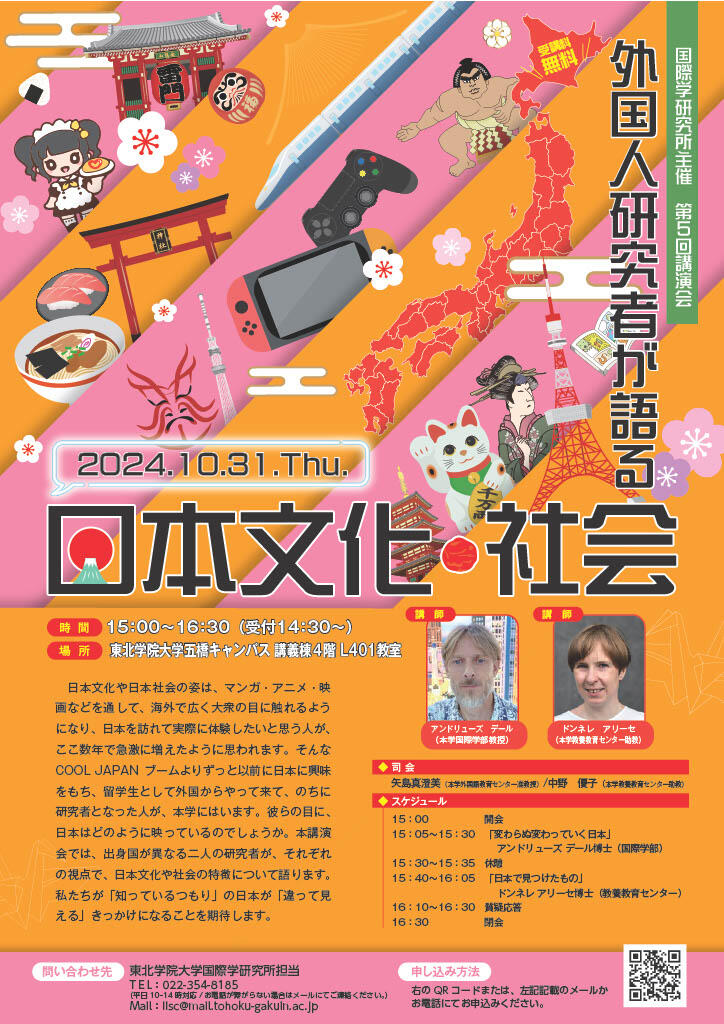
2024年10月31日に東北学院大学国際学研究所の開催する公開講座「外国人研究者が語る日本文化・社会」において「変わらぬ変わっていく日本」という題目で講演しました。
This is a questionnaire given to university students. 大学生に対するアンケート
| 2024年のアンケート(東北学院大学学部生)回答者139名 Survey of 139 Tohoku Gakuin University undergraduates (2024) | Yes | No |
|---|---|---|
| ① Do you have religious beliefs/faith? あなたは「信仰」をお持ちですか? | 15.8% | 84.2% |
| ② Do you have a religion? あなたは「宗教」をお持ちですか? | 21.6% | 78.4% |
| ③ Do you believe in existence of kami (gods/God)? あなたは「神」の存在を信じますか? | 65.5% | 34.5% |
| ④ Do you believe in the existence of the soul after death? あなたは「霊魂」の存在を信じますか? | 57.6% | 42.4% |
| ⑤ Do you believe in yūrei (ghosts)? あなたは「幽霊」の存在を信じますか? | 66.9% | 33.1% |
The three monkeys at Toshogu Shrine in Nikko are famous.

But at Jotokuji temple 常徳寺 in Shikamachi, Ishikawa prefecture, there are four monkeys on the bell tower roof.


This pair of fiberglass schoolboy safety flag holders were photographed at a heavy-traffic intersection in Shirakawago, Gifu Prefecture. Wearing bright yellow coats and boots, a bright red hat, and sporting school bags slung across their backs, these statues resemble many first year elementary school students in Japan, who for safety dress to be seen by motorists. Before crossing the street on their way to school, children take a flag from one holder, and then proceed to cross the street holding it high. Having crossed the street they place the flag in the opposing statue, readying it for their return home. On the top of the statues’ heads is a slot where the flags had once been. And the writing on their chests says who donated the statues, a Mr. Matsuyama Taro. Weathered by years of service and with their flags now gone, the one boy, who lost a hand and broke off from the concrete base, is literally on his last legs. Gokurosan.


People in Japan may call for divine protection when driving or operating a vehicle. Here are some vehicles with various protective devices.


While doing fieldwork in the early 2000s, lost and in need of assistance. Although weathered, the officer remains steadfast in service toward community safety.


